Customer Type: EV Conversion Specialist
Situation
Converting classic cars to electric is complex. Dashboards vary significantly, with design time and quality being vital.
Our client required both hardware and software development – a compact system to interface with the vehicle and multiple different displays, depending on each vehicle project.
When they engaged Argentum Systems, projected unit volumes were small, making bespoke development costs a concern. The system was to be designed around a System-on-Module, and within very specific dimensions.
Problem
Multiple challenges arose:
Size: Our customer identified the “worst case” unit size, and selected a display for the first EV project – Argentum Systems’ design must fit behind this display.
Flexibility: As future conversions occurred, additional displays or uses would be identified by our customer, and support must be added to the system in a cost-effective manner.
Power: Standby power consumption must be minimised, and the customer mandated support for two CAN buses.
Implication
Balancing the high-performance with low-power constraints required careful component selection. While driving, the high resolution displays must present fluid dashboard graphics to the driver; while the ignition is off, the system must monitor the vehicle’s CAN buses with minimal battery energy.
Due to the uncertainty of future displays or use-cases, adaptability and futureproofing were both major considerations.
Outcome
Argentum Systems designed multiple software and hardware elements for this EV solution, employing both Linux and Zephyr.
Powerful: System-on-Module
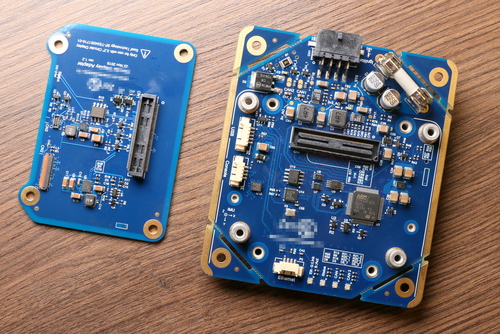
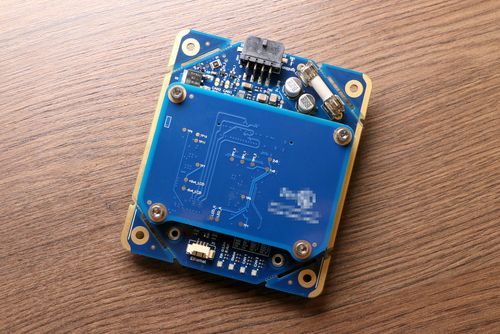
Simple: Refitting via a swappable adapter
Enhanced: Power management
Rapid: Cost effective reconfiguration
Since the initial design, Argentum System has adapted the unit to support multiple further displays.
Technical Journey (hide)
Our customer required a performant system that fits in a tight space envelope; with a low power budget during the prolonged idle periods that vehicles can be subjected to. An exploration phase capture their requirements and produced formal documentation outlining the project's path – this included some initial suggestions for the system architecture and physical design. At this early stage it became apparent that the system could potentially be re-used for other roles within the vehicle, making flexibility a desirable asset.
The vehicle conversion projects often introduce multiple CAN busses, providing isolation for the drive train and other critical systems. In order for the digital dash systems to display useful information, access to two CAN busses was mandated. An "ignition" signal instructs the system to turn on the display, and could be delivered via either a digital 12v signal or one of the CAN busses.
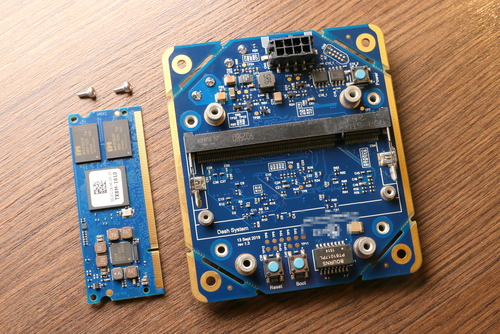
An i.MX8 System-on-Module was employed to drive the high resolution displays, paired with an STM32 as a co-processor to manage the CAN busses and system power. Adapter modules connect via a high-speed connector, facilitating auto-detect, MIPI DSI, MIPI CSI, PCI Express, USB, and a number of other interfaces. This design gives the system incredible flexibility, allowing future support for not only displays, but high resolution cameras, cellular connectivity, and any number of other peripherals and sensors.
Argentum Systems adapted the SoM's Yocto BSP to incorporate support for the new base board, adapter modules and associated displays. Support for the chosen STM32 was implemented in Zephyr and upstreamed as part of this project. A Linux USB driver was developed to allow system configuration and provide transparent access to the CAN busses. Special steps were taken to ensure that the transmission on the CAN busses is impossible unless an unlock procedure is followed.
A partner implemented the hardware-accelerated graphical application presented on the displays, and together we delivered a solution that satisfied the requirements laid out at the beginning of the project. Over the course of this engagement, we implemented support for three different displays, each with their own adapter module.