Customer Type: Integrated Hygiene Solutions
Situation
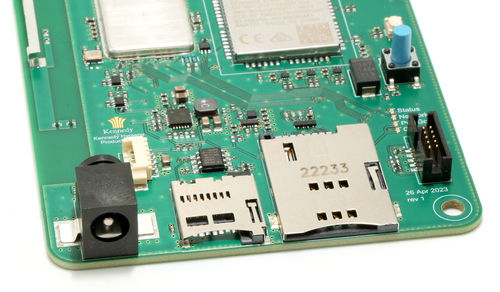
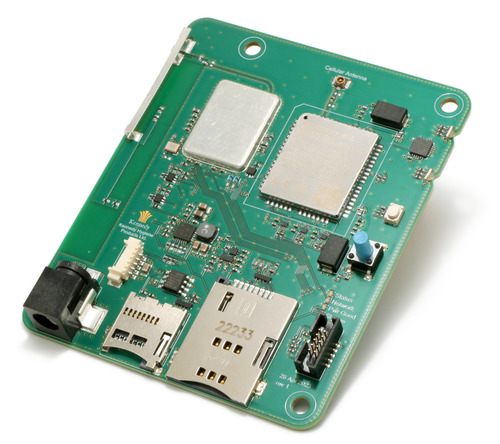
Our customer’s existing IoT gateway faced cost, performance and obsolescence challenges. We were engaged to revise the design for use with both new and existing products.
The legacy system used a bespoke radio protocol, and a cellular link to communicate with their cloud service. New product concepts on the horizon were expected to use the same equipment in due course.
The revised design must operate as a drop-in replacement, with performance and reliability enhancements that match or exceed the current offering. Care must be taken to reduce impact on existing enclosure tooling and assembly processes.
Approach
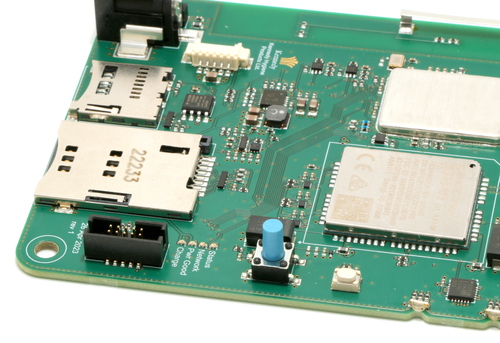
Tasked with revising one of the device’s two PCBs, after careful review we proposed a full redesign, allowing for smaller electronics, simpler assembly and further cost reductions. This would also reduce the custom firmware count from three to just one.
Ensuring reliable message delivery was vital – the gateway must “buffer” messages if the cloud service was ever unreachable. The device must also be fully operational for at least 24 hours without mains power.
Limited radio protocol documentation was overcome by reviewing firmware sources and analysis of radio signals. Components were selected, and compatibility was quickly confirmed with off-the-shelf development tools.
Implication
The full electronics redesign allowed for a number of opportunities – such as a hidden requirement to remove all external antennas. The selection of new components also allowed us to offer use of the LoRa radio protocol with our customer’s new products, a follow-on project which we have since completed and included the design of a radio protocol and HTTP API.
We took the project from the initial requirements capture, through design, prototyping, development, and EMC & Radio Compliance testing. Afterwards, we supported hand-off to our customer’s Contract Manufacturer for production, and supported with design and development of a test jig and associated production-line tools.
Outcome
The new gateway design was tested, found to exceed the customer’s original operational scope of requirements, and was verified as a direct drop-in replacement.
Since completion of the original project, we have offered support and services for a number of extensions and modifications to the device. One such extension is the development of a LoRa-based system for a new line of products, paired with the associated compliance re-testing.
Technical Journey (hide)
After initial discussions, our customer supplied equipment for us to inspect – a previous generation gateway, with a handful of sensor devices. Paired with the documentation and source code available, we used a Software Defined Radio to observe and decode traffic between these existing devices. This led to some important clarifications of the protocol and the retransmission scheme used.
With a good understanding of the radio protocol, we investigated options for the new system that met the target unit cost. We settled on the SAMR35 System-in-Package from Microchip for the main processor, which includes both a Microchip SAML21 (with an ARM Cortex-M0+) and a Semtech SX1276 series radio. Using off-the-shelf development tools, we quickly implemented a "sniffer" that allowed us to decode packets, along with basic firmware to verify two-way communication with the sensor devices in place of the original gateway.
Once the initial schematic was completed, we provided drawings and a simplified 3D model of the PCB, allowing verification of the mechanical fit with existing enclosure plastics. Buttons, LEDs and fixing holes were carefully placed for compatibility, and only minimal modifications to the injection mould tooling was required. The battery and antenna locations were also decided at this point, and the PCB layout could commence.
With the first prototype hardware in hand and bringup completed, development of the new gateway's firmware could commence. We implemented and upstreamed Zephyr support for the SAML21 and SAMR34/35 series parts, and produced a handful of private application-specific drivers. The FRAM layout was designed, supporting the required packet buffering, and far exceeding the previous gateway's capacity. Connectivity to the cloud service was established, and testing could begin.
A day of pre-compliance testing was conducted before the formal EMC and Radio Compliance testing began – the equipment passed with no major issues, much to our delight. One revision of the electronics was required to address some minor errors, and the hand-off to our customer's Contract Manufacturer for production volumes went smoothly.
Since completion of the original project, we have extended functionality of the same hardware with a new LoRa-based protocol, used by a new series of products. This work also included the design of the new radio protocol and HTTP API.